
What is the EU Pay Transparency Directive?
If you have been hearing about EU pay transparency but have not quite nailed down what it actually requires, you are not alone. There is a lot of noise out there - law firms writing opinion pieces, software companies pitching their products, and LinkedIn hot takes - and it can be hard to separate what is actually in the Directive from what people think is in the Directive.
Here is what we know for certain. The EU Pay Transparency Directive - Directive (EU) 2023/970 - was adopted on 10 May 2023. It aims to strengthen the principle of equal pay for equal work or work of equal value between men and women, and it does this by making pay more transparent and giving workers and regulators new tools to enforce it (Debevoise & Plimpton - full overview).
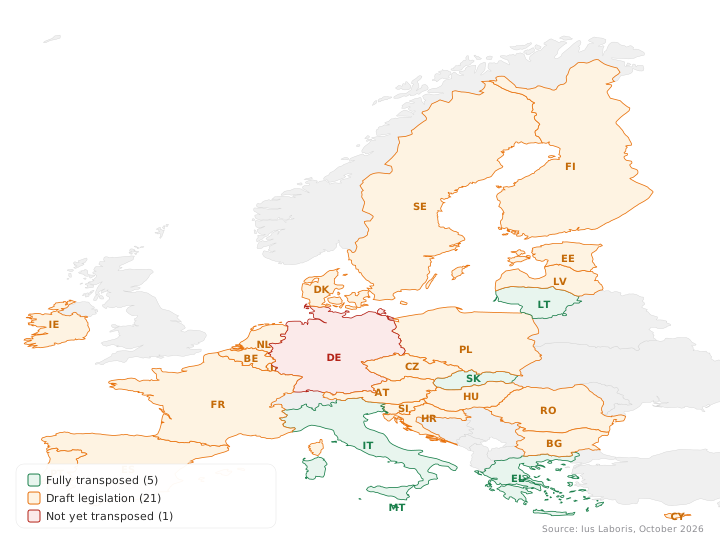
Member States were required to transpose the Directive into national law by 7 June 2026. That deadline has passed. As of October 2026, only five Member States have fully transposed it - Slovakia, Lithuania, Italy, Malta and Greece. Germany has not yet published a draft bill. France presented its transposition bill in September 2026. Ireland has confirmed a phased approach with no firm timeline (Ius Laboris - transposition tracker, October 2026).
Why does this matter now?
Because the obligations do not wait for national transposition. The reporting deadlines are fixed in the Directive itself. Every employer with 150 employees or more needs to submit their first gender pay gap report by 7 June 2027. That first report will be based on the 2026 pay data - which means the clock is already running.
Who does the EU Pay Transparency Directive apply to?
This is one of the most misunderstood parts of the Directive. The short answer: it applies more broadly than most people think.
Which types of company are covered?
Article 2(1) is clear: the Directive "applies to employers in public and private sectors." It does not matter whether you are a listed company, a private business, a charity, a university, or a government body. If you employ people in an EU Member State, you are in scope (Debevoise & Plimpton - who is covered).
Does company size matter?
Yes and no. The obligations that apply to every employer - salary ranges for applicants, no pay history questions, right to information, pay-setting criteria - are not limited by size. But gender pay gap reporting under Article 9 is phased by the number of workers you employ (KPMG - reporting thresholds):
| Employer size | Reporting frequency | First report due | Directive source |
|---|---|---|---|
| 250+ workers | Annual | 7 June 2027 | Art. 9(2) |
| 150-249 workers | Every 3 years | 7 June 2027 | Art. 9(3) |
| 100-149 workers | Every 3 years | 7 June 2031 | Art. 9(4) |
| Under 100 | Voluntary | - | Art. 9(5) |
These are the Directive minimums. Countries can set lower thresholds. France, for example, retains its reporting threshold to apply to companies with 50 or more employees - from its existing national legislation (beqom - transposition by country). The rule is always: the Directive is the floor, not the ceiling.
Which employees are covered by the EU Pay Transparency Directive?
Article 2(2) covers all workers with an employment contract or employment relationship as defined by national law. That includes part-time, fixed-term, temporary agency and platform workers where they meet the criteria. The test is the reality of the working relationship, not what the contract says - Recital 18 calls this the "facts over labels" principle (Pinsent Masons - scope of the Directive).
For the pre-employment rules (salary ranges and the ban on pay history questions), the Directive also covers job applicants (Art. 2(3)).
If you use Employers of Record (EORs) or have contractors who might be classified as workers under national law, this is worth a conversation with your legal team. The Directive looks at the reality of the relationship, not the label on the contract.
What if your company is headquartered outside the EU?
The Directive is based on where your workers are, not where your headquarters is. So if you are a US, UK or Swiss company with employees in an EU Member State, you have obligations under this Directive. Your recruitment process needs to comply with Article 5 (salary ranges, no pay history questions, gender-neutral job ads) for any EU-based role. And if you hit the reporting thresholds in any Member State, you need to report (KPMG - applicant obligations).
This is particularly relevant for companies that hire remotely across borders. If your careers page lists roles in Germany, France or the Netherlands, the Directive applies to those postings - even if your legal entity is in London or New York.
What does every employer have to do - regardless of size?
This is where most of the confusion starts. The reporting thresholds get all the attention. But several obligations in the Directive apply to every employer - and they are already in force in Member States that have transposed (EmploySome - obligations by employer size). Here is the list:
- Provide applicants with the initial pay or its range before the interview, based on objective, gender-neutral criteria (Art. 5(1)). Some Member States go further - Ireland will require the range in the job advert itself, not just before the interview.
- Never ask applicants about their pay history - current or previous employment (Art. 5(2)). No exceptions, no workarounds.
- Job adverts and job titles must be gender-neutral (Art. 5(3)).
- Pay-setting and pay progression criteria must be easily accessible to workers, on objective, gender-neutral terms (Art. 6(1)). If your pay decisions are based on informal practice or manager discretion with no documented framework, that is a problem.
- Respond to worker requests for pay information in writing within two months (Art. 7(1) and 7(4)). Your Member State may shorten this.
- Tell all workers, every year, that they have the right to request this information and how to do it (Art. 7(3)).
- No pay-secrecy clauses in contracts. Workers cannot be prevented from disclosing their own pay for the purpose of enforcing equal pay (Art. 7(5)).
Workers can already request pay information
This is the obligation that catches most employers off guard. Under Article 7(1), any worker can request, in writing, their own pay level and the average pay levels - broken down by sex - for workers doing the same work or work of equal value. The employer must respond within two months (CMS Law - how the Directive reshapes employer obligations).
Two important clarifications. First, the Directive does not require you to publish individual salaries or build a self-service pay lookup. The European Commission FAQ specifically states the Directive "does not ever require disclosing individual pay data, only average pay levels in categories of workers." So this is the principle of maintaining GDPR protections for employees. Second, the two-month window is a maximum. Some Member States may set shorter deadlines - Malta, for example, requires employers to respond within just eight calendar days (Lewis Silkin - Malta's transposition).
Can you actually answer this request today? Do you know what your categories of workers are? Do you have the data to calculate average pay by sex for each category? If the answer to any of those is no, that is your starting point - regardless of whether your Member State has transposed or not.
What goes into the gender pay gap report?
Article 9(1) sets out seven metrics. They are all unadjusted - the Directive does not require an adjusted pay gap. An adjusted analysis is something you might use to justify a gap, but it is not a reporting requirement:
- (a) The gender pay gap (mean).
- (b) The gender pay gap in variable and complementary pay (mean).
- (c) The median gender pay gap.
- (d) The median gap in variable and complementary pay.
- (e) The proportion of women and men receiving variable or complementary pay.
- (f) The proportion of women and men in each quartile pay band.
- (g) The gender pay gap by category of workers, split by basic pay and variable components.
Metrics (a) to (f) go to the national monitoring body and are published. Metric (g) - the per-category breakdown - goes to workers and their representatives.
The per-category breakdown (g) is where most of the operational challenge sits. You need to define your categories of workers - groups doing the same work or work of equal value - using objective, gender-neutral criteria. If your roles are not grouped consistently, you cannot produce this metric. This is where job architecture becomes essential.
What triggers a Joint Pay Assessment?
A Joint Pay Assessment under Article 10 is triggered only when all three of these conditions are met (Osborne Clarke - JPA deep dive):
- The reporting shows a pay gap of at least 5% between female and male workers in any category of workers.
- The employer has not justified the gap on objective, gender-neutral criteria.
- The employer has not remedied the gap within six months of submitting the report.
The 5% is per category, not a company-wide figure. All three conditions must be met. The assessment is conducted with worker representatives and must include concrete measures to fix unjustified gaps. Member States may set a lower trigger than 5%.
Not sure where to start with EU pay transparency?
See how our Pay Transparency Software can help you.
The Directive is a minimum - your country may go further
Article 27(1) explicitly allows Member States to go beyond the Directive. This is not theoretical - it is already happening:
- France retains its reporting threshold to apply to companies with 50 or more employees.
- Ireland will require salary ranges in job advertisements, not just disclosed before the interview.
- Malta requires employers to respond to Article 7 pay information requests within just eight days - a fraction of the Directive's two-month maximum (Lewis Silkin - Malta's transposition).
- Germany has not yet published draft legislation and is targeting early 2027 for entry into force, with some provisions potentially delayed to 2028.
- Lithuania and Denmark have signalled additional requirements beyond the Directive baseline.
Track the latest transposition status at the Pay Transparency Tracker or through Trusaic's transposition updates. For a country-by-country breakdown, see Corp International's status guide (September 2026).
If you operate across multiple EU countries, you cannot build to one rulebook. The Directive is your baseline, but each country may have different interpretations and requirements. Start with the Directive, then check each country where you have workers and the draft legislation or transposed local law. And keep checking - transposition is still unfolding.
What happens if you do not comply with the EU Pay Transparency Directive?
The Directive is designed to have real consequences. Here is what is at stake:
The burden of proof shifts to you.
This is the provision that changes the game. If you have not met your transparency obligations - pay ranges, pay-setting criteria, right to information, reporting - and a worker accuses you of pay discrimination, it falls to your company to prove there was no discrimination. Not the employee. The only exception is where the breach was "manifestly unintentional and of a minor character" (Art. 18(2)). In practice, that is a high bar to clear (Debevoise & Plimpton - burden of proof).
Think about what that means day to day. If you cannot show how you set pay, how you determined worker categories, or why two people in the same category earn different amounts - and someone asks - you are already on the back foot.
Compensation is uncapped.
A worker who has been discriminated against can claim full back pay, bonuses, compensation for lost opportunities and non-material damage - with no upper limit. Art. 16(4) states compensation "shall not be restricted by the fixing of a prior upper limit" (Boundless - enforcement and penalties).
Fines are mandatory.
Member States must set "effective, proportionate and dissuasive penalties" including fines, which may be based on annual turnover or total payroll (Art. 23). The specific fine levels are set by each Member State, not the Directive. Malta, for example, has introduced criminal penalties with fines of EUR 2,500 to EUR 7,000 (Debevoise & Plimpton - penalties).
GDPR fines apply separately.
All pay-data processing is governed by the GDPR (Art. 12(1)). A pay-data breach can draw a separate GDPR fine of up to 4% of worldwide turnover or EUR 20 million. This is a GDPR ceiling, not a Directive fine (GDPR Art. 83(5)).
Your company could lose public contracts.
Contracting authorities may exclude bidders with an unjustified pay gap of more than 5% in any category, or who have failed to comply with pay transparency obligations (Art. 24).
Claims can go back years.
Limitation periods must be at least three years and do not start running until the worker becomes aware of the infringement (Art. 21(1)). In some Member States, the clock may not start until after the employment relationship ends.
What should you do now?
If you employ people in the EU and have not started preparing, here is a practical checklist:
Map your roles into defensible, gender-neutral categories
Article 4(4) requires pay structures based on "skills, effort, responsibility and working conditions." If your job levels were invented team by team with no consistent framework, start here.
Document your pay-setting criteria
Article 6(1) requires these to be "easily accessible" to workers. If your criteria exist only as informal practice or manager discretion, they need formalising.
Understand what "pay" means
It is not just base salary. Article 3(1)(a) includes bonuses, overtime, allowances, benefits in kind and employer pension contributions. If you are not tracking all of these, your reporting will be incomplete.
Get ready to answer worker requests
Article 7 is live now in countries that have transposed. Any worker can ask. You need to respond in writing within two months - or eight days in Malta.
Fix your job adverts
Article 5 requires salary ranges for applicants, gender-neutral job titles, and bans pay history questions. If your recruitment process still asks "what are you on now?" - that needs to stop.
Start planning your first gender pay gap report
If you have 150 or more workers, start planning your first gender pay gap report now. The data year is 2026 for the 7 June 2027 deadline. If you have 100-149 workers, your deadline is 2031, but the smart move is to start early.
Join one of our free webinars on EU pay transparency - from getting started with reporting to choosing the right software. See upcoming events.
Frequently asked questions
What is the EU Pay Transparency Directive?
The EU Pay Transparency Directive - Directive (EU) 2023/970 - is an EU law that strengthens equal pay for equal work between men and women. It requires employers to make pay more transparent, give workers the right to pay information, and report their gender pay gap. Member States were required to transpose it by 7 June 2026, though most missed the deadline.
Which employers does the EU Pay Transparency Directive apply to?
The Directive applies to employers in public and private sectors across the EU (Art. 2(1)), including companies headquartered outside the EU if they employ people in a Member State. Gender pay gap reporting applies to employers with 100 or more workers, with phased deadlines from June 2027 to June 2031.
When is the first gender pay gap report due under the EU Pay Transparency Directive?
Employers with 250 or more workers must submit their first gender pay gap report by 7 June 2027, covering the 2026 data year, then annually. Employers with 150 to 249 workers report by the same date, then every three years. Employers with 100 to 149 workers report from 7 June 2031.
Can a worker request pay information under the EU Pay Transparency Directive?
Yes. Under Article 7(1), a worker can request their own pay level and the average pay levels, broken down by sex, for workers doing the same work or work of equal value. The employer must respond in writing within two months - though Malta requires just eight days. The Directive does not require disclosing individual pay - only category averages.
What happens if an employer does not comply with the EU Pay Transparency Directive?
Non-compliance can result in the burden of proof shifting to the employer in pay discrimination cases (Art. 18), uncapped compensation including full back pay (Art. 16), fines set by each Member State (Art. 23), exclusion from EU public procurement (Art. 24), and separate GDPR penalties for pay-data breaches.
What is a Joint Pay Assessment under the EU Pay Transparency Directive?
A Joint Pay Assessment is required when gender pay gap reporting shows a gap of 5% or more in any category of workers, the gap is not justified on objective gender-neutral criteria, and it has not been remedied within six months. All three conditions must be met. It is conducted with worker representatives.
Which countries have transposed the EU Pay Transparency Directive?
As of October 2026, five Member States have fully transposed: Slovakia, Lithuania, Italy, Malta and Greece. France, Germany and Ireland are among the large economies still in progress.
About this article
This article was researched and written with the help of AI. We review all content for accuracy. This article was published on 19 October 2026 and the information cited may have changed since then. This is not legal advice - always consult a qualified professional for your specific situation.