Implementation was really straightforward and it was easy to see how the data applied to our roles and where things might be slightly different.
Emily A.
Head of People Operations
One framework for every role, every grade and every person in your organisation - so pay is fair and every decision holds up to scrutiny. No consultants. No black-box scoring. No guesswork.
Loved by People Teams








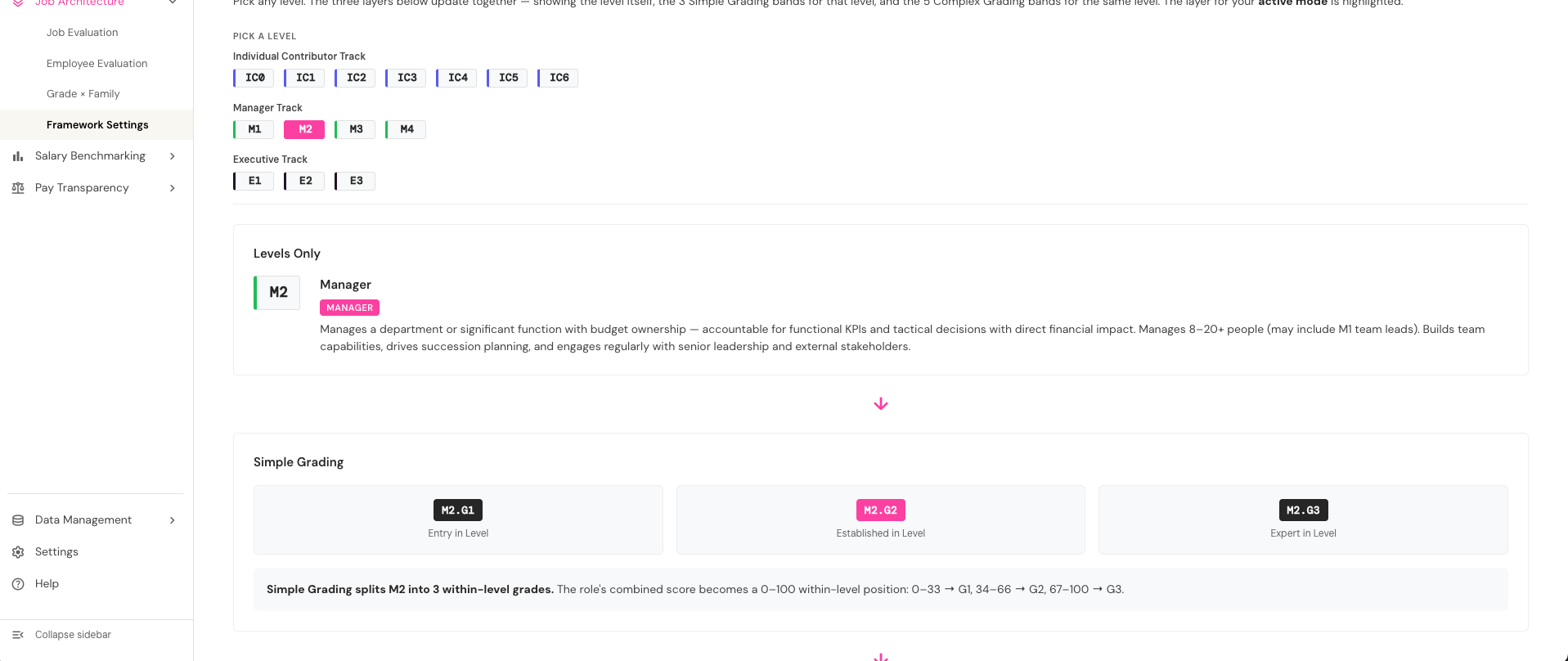
Compensation IQ gives you one shared framework - families, sub-families, levels and grades in one structure - that fixes all four at once and feeds Salary Benchmarking and EU Pay Transparency directly.
Every manager stops inventing their own titles. One framework describes what each role is for and how it compares - across the whole organisation.
Grading evaluates the size and complexity of each role, so work of equal value is paid consistently - the foundation for fair pay decisions.
Clear levels and progression criteria show every employee how to advance, vertically or laterally, and exactly what each step requires.
Levels and grades underpin market benchmarking, salary bands and EU Pay Transparency Directive reporting - as legitimate control factors in the adjusted pay gap.
Job evaluation usually comes in two forms: a consultancy project that takes months to deliver, or a black-box tool where nobody can explain the grade to a manager. Compensation IQ does it in one product.
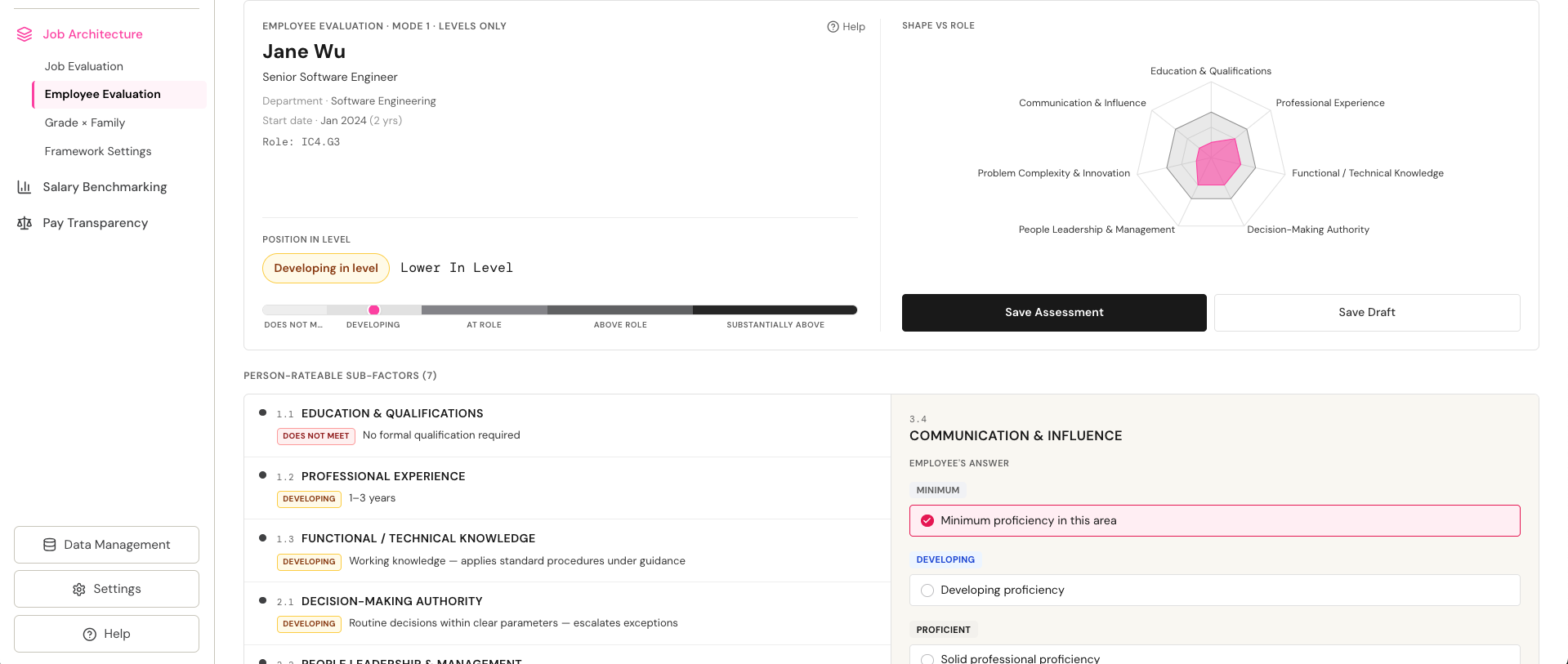
A pay gap is only defensible when you can explain what drives it. Compensation IQ evaluates every employee against the role they hold, so the difference between the two becomes the number reward decisions can act on.
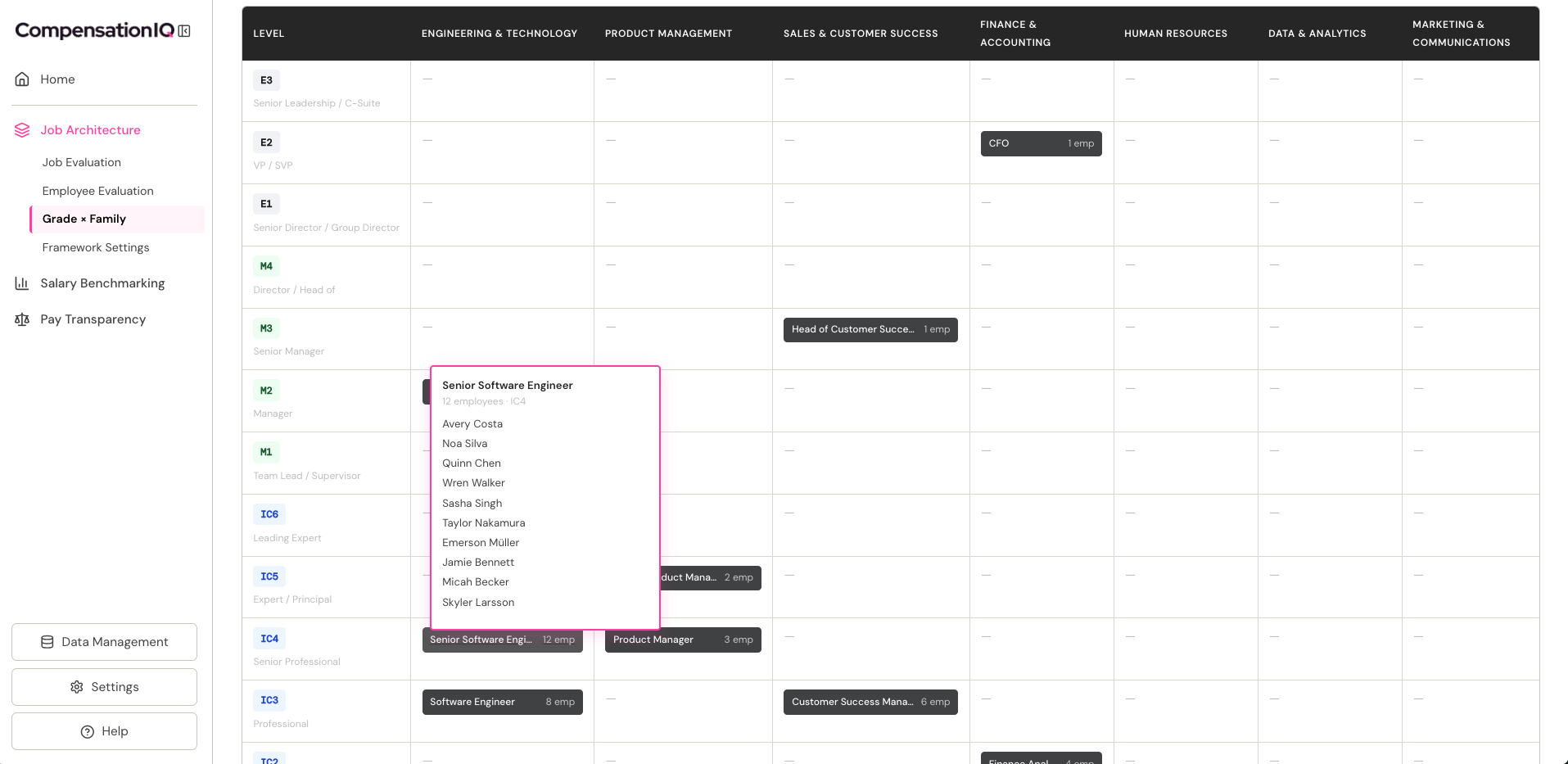
Once every role is levelled, the shape of the organisation becomes visible. The Grade x Family matrix plots every role against its level and its function - surfacing the structural gaps and clusters hiding in the org chart, and revealing the progression routes every employee can take, vertically or laterally.
Implementation was really straightforward and it was easy to see how the data applied to our roles and where things might be slightly different.
Emily A.
Head of People Operations
I appreciate the customizable data that fits our company needs and the easy comparison of benchmarks. The split of data sets available makes it much easier to understand differences.
Stephanie B.
People Director
I like how you are able to combine benchmarking data sets together to create ranges based on job posts and salary data from Mercer.
Verified User
Consulting
We understand the sensitivity of compensation data. That’s why Compensation IQ is built with security and integrity first. Our practices are aligned with ISO 27001 and our policies and procedures are compliant with GDPR.

SOC 2

GDPR

Cyber Essentials
Compensation IQ Job Architecture and Levelling is a job architecture and job evaluation product that helps HR teams build and maintain a structured framework for their organisation. Upload your org data and the product maps every role to one of 34 job families, assigns levels automatically across our fourteen-level framework (three career tracks: Individual Contributor, Manager, Executive), and scores each match for confidence. You can translate your framework to 30+ external benchmarking standards including Mercer IPE (International Position Evaluation), Korn Ferry Architect: Job Architecture Software, Willis Towers Watson Global Grading System (WTW GGS), Radford McLagan and AON McLagan, and export results in minutes. It forms the foundation for both Compensation IQ Salary Benchmarking and Compensation IQ EU Pay Transparency reporting.
Job architecture is the whole framework: the levels, the families, the sub-families and the way roles relate to each other. Job levelling assigns each role a place on that framework - which of the fourteen Compensation IQ levels the role belongs to. Job evaluation grades how much a role demands within its level, using a scored point-factor method against fourteen sub-factors covering skills, responsibility, effort and working conditions. Compensation IQ Job Architecture and Levelling does all three in one product - levelling is compulsory, grading is optional.
Compensation IQ groups every role into a four-level taxonomy. At the top sit 34 job families - broad domains such as Engineering & Technology, Finance, People & HR, Sales, and Operations. Each family breaks into sub-families (255+ across the taxonomy) - narrower disciplines like Software Engineering, Financial Planning & Analysis, or Talent Acquisition. Each sub-family contains specialisations (532+ in total) - specific role types such as Backend Software Engineer, FP&A Manager, or Senior Recruiter. Every specialisation resolves to canonical job titles, more than 21,000 in the current library. When you upload your organisation's data, Compensation IQ maps every one of your existing titles to this shared taxonomy automatically - so market benchmarking, salary range design and pay-equity reporting all speak the same language across the whole company.
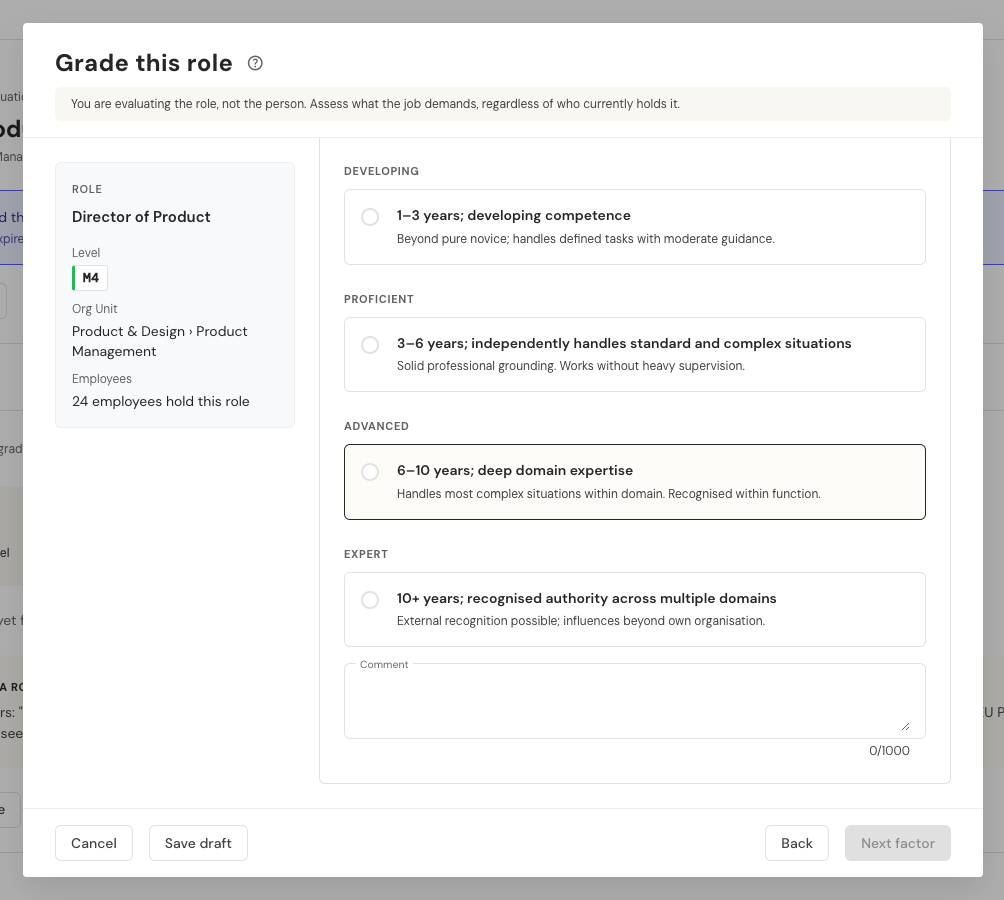
Every role is graded against fourteen sub-factors covering skills, responsibility, effort and working conditions - the four factor categories the EU Pay Transparency Directive explicitly names. Managers answer plain-English questions about the job description; the platform calculates the grade behind the scenes. The result is a defensible Level.Grade score (for example, M4.G4, 77/100) with the factor evidence attached.
The traditional providers deliver job evaluation as a consultancy project. Mercer's International Position Evaluation methodology (Mercer IPE) uses a proprietary point-factor scoring system applied by Mercer consultants over months of work, with a fixed weighting scheme owned by Mercer. Korn Ferry Architect: Job Architecture Software is Korn Ferry's HR technology product built around the Korn Ferry Hay Guide Chart-Profile Method, historically delivered as a Hay Group consultancy engagement. Willis Towers Watson Global Grading System (WTW GGS) follows a similar consultancy-led pattern with WTW's own methodology.
All three deliver rigour, but with a fixed methodology, an ongoing consultancy dependency for every change, and a licence model that is hard to justify below enterprise headcount.
Compensation IQ delivers the same point-factor rigour as software: level a role in seconds, grade it in minutes, own the framework from day one. If you already use Mercer IPE, Korn Ferry Hay or WTW GGS, Compensation IQ maps your existing values to Compensation IQ Levels and Grades automatically - with a confidence rating on every row - and keeps your original values visible everywhere they need to be, including on the EU Pay Transparency Directive Article 7 information response.
gradar is a standalone job grading tool built around a single point-factor methodology, applied uniformly across every role. RoleMapper is an AI-powered workspace for job data and job description management, with formal job evaluation still in development. Both are single-purpose products: they help you build a levelling and grading framework, and stop there.
Neither gradar nor RoleMapper offers integrated salary benchmarking. Neither is designed to power EU Pay Transparency Directive compliance. If you choose gradar or RoleMapper, you get a levelling and grading system - and then you still need to buy a separate salary benchmarking provider (Mercer, Radford, AON McLagan, Culpepper, Payscale, or similar) and a separate pay-transparency compliance product to meet the EU directive's Article 7 and Article 9 reporting obligations. You end up integrating three tools that were never designed to work together.
Compensation IQ delivers the same point-factor rigour as gradar - fourteen sub-factors, three grading depths (Levels Only, Simple Grading, Complex Grading), and 30+ external frameworks pre-mapped - and packages it inside a three-product platform:
Compensation IQ Job Architecture and Levelling (this product) - the framework layer. Compensation IQ Salary Benchmarking - multi-source pay data across 5m+ companies, 100+ countries and 100+ industries, with salary range design and pay analytics built in. Compensation IQ EU Pay Transparency - adjusted pay-gap analysis using your levels and grades as legitimate control factors, plus automated Article 7 information response generation.
Level a role once in Compensation IQ, and it powers your benchmarking, your salary bands and your directive compliance without re-entry. One framework, one login, one shared taxonomy for the whole organisation - not three products bolted together.
Levelling is compulsory; grading is optional. Choose Levels Only for a clean fourteen-level structure, Simple Grading for three within-level grades (G1-G3), or Complex Grading for full point-factor scoring across fourteen sub-factors. Start light and upgrade to point-factor when compliance or pay-equity needs demand it. The level assigned to a role stays put through any upgrade - nothing is lost.
Every level and grade flows directly into the other two Compensation IQ products. Salary Benchmarking uses your levels for like-for-like market comparisons and salary range design. Pay Transparency uses your grades as legitimate control factors in the adjusted pay-gap analysis and reproduces them on the Article 7 information response. Level a role once, and it powers benchmarking, ranges and compliance without re-entry.
Compensation IQ Job Architecture and Levelling is a paid product designed to be affordable for HR teams of any size. Pricing is banded by headcount. See our pricing page for details, or book a demo and we will price it for your team.
Compensation IQ Job Architecture and Levelling is priced by headcount and is designed to be affordable for HR teams of any size. Your subscription includes: point-factor evaluation across fourteen sub-factors covering skills, responsibility, effort and working conditions; three grading depths (Levels Only, Simple Grading and Complex Grading); Employee Evaluation with the Shape versus Role radar and Position in Level scoring; the whole-organisation Grade x Family matrix; and pre-mapped translations to 30+ external frameworks including Mercer IPE, Korn Ferry Hay, Willis Towers Watson Global Grading System (WTW GGS), Radford McLagan, AON McLagan, Culpepper, Figures, Pave, Ravio and Workday Job Architecture. See our pricing page for details, or book a demo and we will price it for your team.