Built for EU Pay Transparency compliance

From Article 7 requests to Article 9 reporting - EU PTD compliance built for HR

Everything HR needs to answer right-to-know requests, categorise pay components, prove equal-value categories, and submit gender pay reports. Built for the EU. Built for HR.
See pricing →
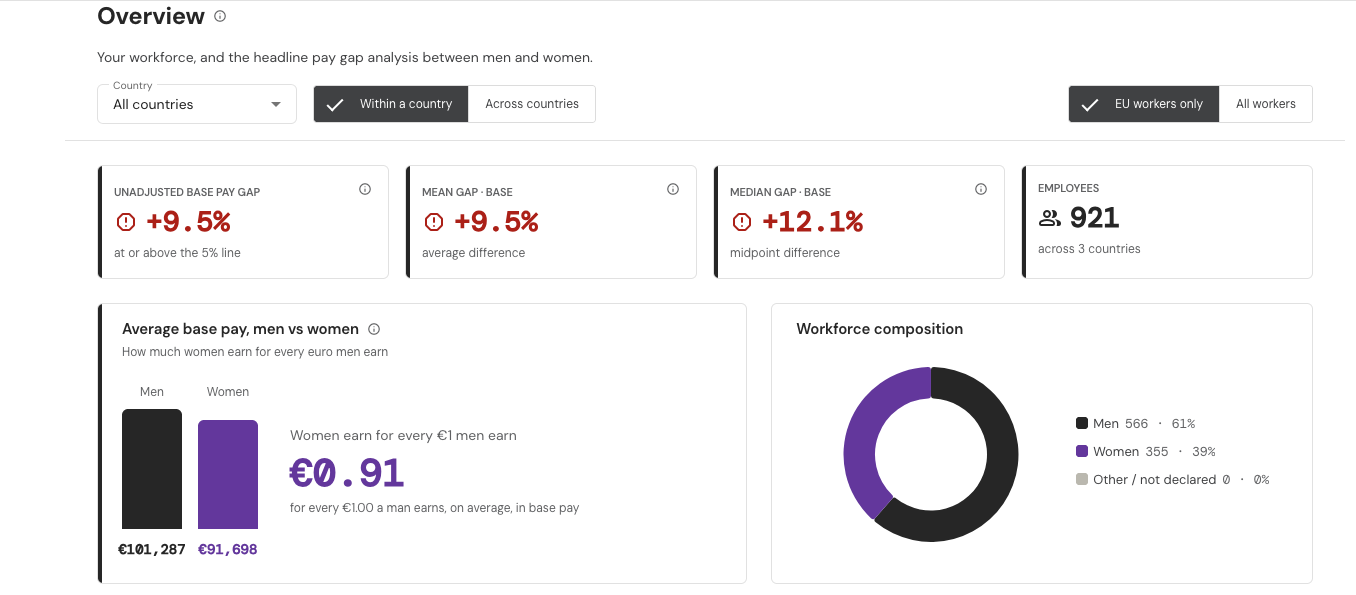
Compensation IQ EU Pay Transparency dashboard showing the organisation-wide gender pay gap overview

Loved by People Teams

Torchbox
Hertility Health
Zoomo
About:Energy
Brainlabs
Ocean Bottle
The News Movement
Greenpark Digital
The Directive

More than a pay gap report

Ten obligations under Directive (EU) 2023/970. Most apply to every employer, regardless of size.

1

Article 5 - Recruitment transparency

Salary ranges disclosed in job postings. Ban on salary history questions.

2

Article 7 - Right to information

Any worker can request pay data by gender. Two-month written response.

3

Article 9 - Gender pay gap reporting

Seven statutory metrics to the monitoring body. Phased by headcount, 250+ workers first.

4

Article 18 - Burden of proof

In discrimination claims, the employer must prove no discrimination occurred.

Step 1 of 4 · Connect

Bring every pay component into one place, across every country

Pay data lives in your HRIS, in country payroll systems, and in the spreadsheets in between. Compensation IQ pulls it all into one validated view - ready for the Directive.

  • 50+ HRIS integrations, read-only
  • Guided CSV for country payroll systems
  • Real-time validation as records load
  • Multi-country, multi-language, multi-currency
Compensation IQ EU Pay Transparency employee view showing pay data pulled together from HRIS, payroll and spreadsheet sources
Step 2 of 4 · Categorise

Categorise every pay component under Article 3, with the citation stored per decision

Article 3 defines “pay” as far more than salary - bonuses, allowances, benefits in kind, occupational pensions. Compensation IQ classifies every component under Article 3 and stores the citation against every decision.

  • Auto-classifies base pay, variable, allowance, benefit in kind
  • Article 3 citation stored per decision
  • Country pay components in their local language (Weihnachtsgeld, dodatek, thirteenth-month)
  • Full audit trail, versioned, exportable
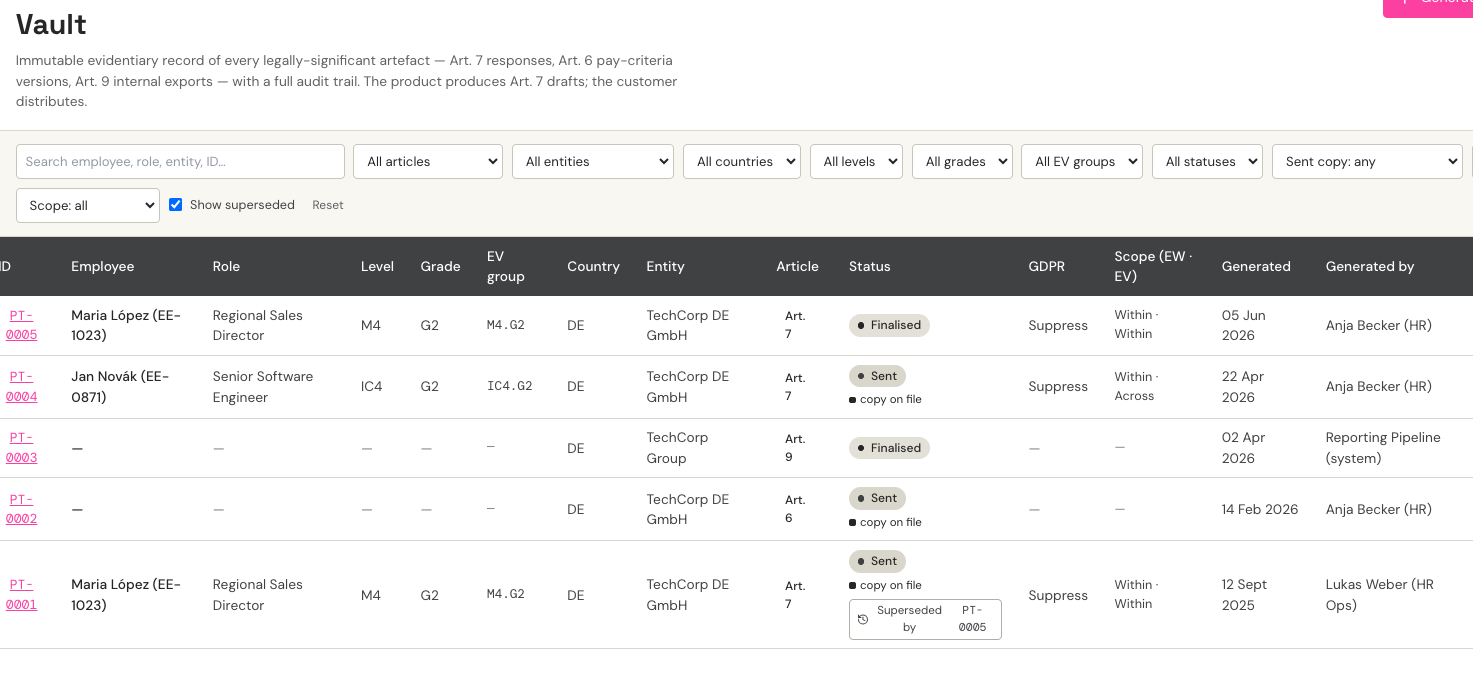
Compensation IQ EU Pay Transparency audit trail showing every pay component classification decision, time-stamped and versioned
Step 3 of 4 · Calculate

Run the gender pay gap the way the regulator will - unadjusted and adjusted

Article 9’s seven statutory metrics, generated automatically. Unadjusted for the headline. Adjusted for level, tenure, location and skills - so HR knows what’s structural and what isn’t. Equal-value categories built in Job Architecture, included.

  • Unadjusted gender pay gap, mean and median
  • Adjusted gap for level, tenure, location, skills
  • All seven Article 9 metrics in the format the monitoring body expects
  • Categories of workers from Article 4 equal-value criteria
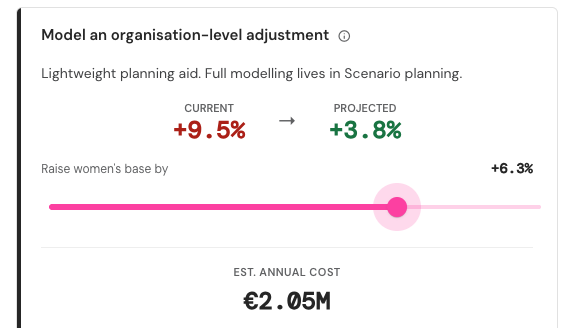
Compensation IQ EU Pay Transparency adjusted pay gap model controlling for job level, tenure, location and skills
Step 4 of 4 · Comply

Answer every right-to-know request and submit every Article 9 report from one workflow

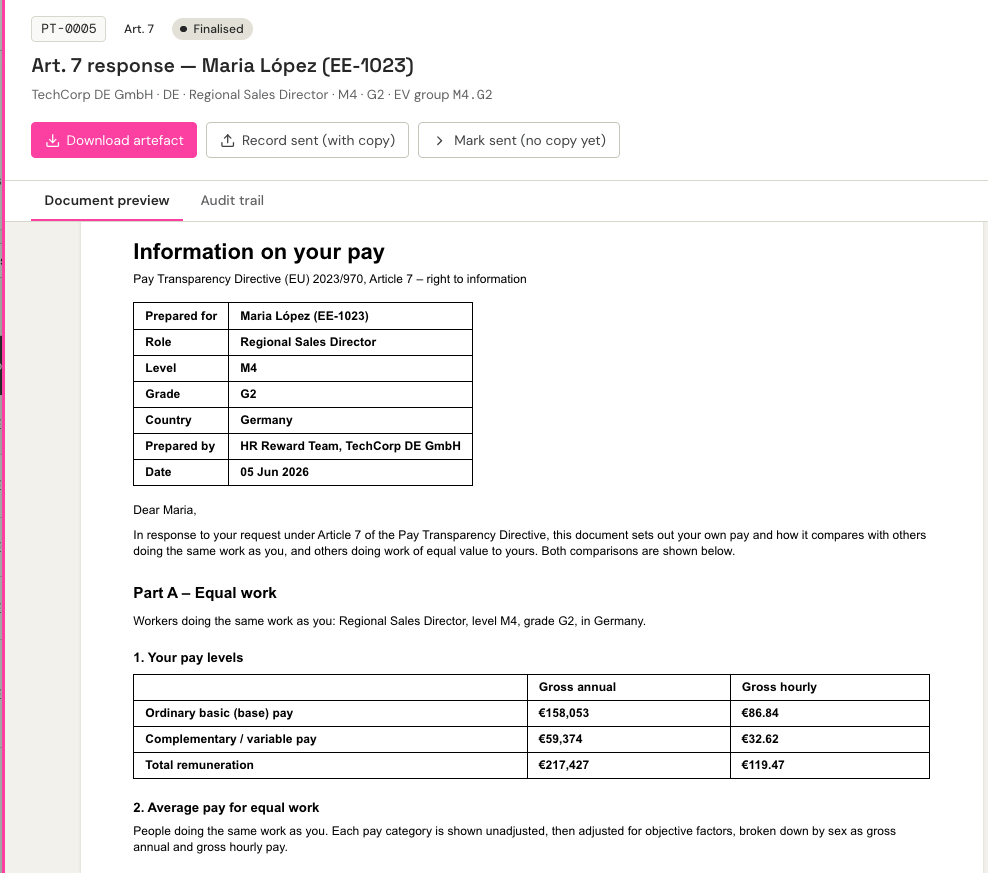
Answer any Article 7 request in the two-month window. Submit the Article 9 report when it applies to your headcount. Every calculation versioned. Every citation held. Every number traceable.

  • Article 7 response generated from your categorised data
  • Article 9 reports in the monitoring body’s format, per headcount cadence
  • Every calculation versioned and retained
  • Article 18 documentation: every number traceable to its source
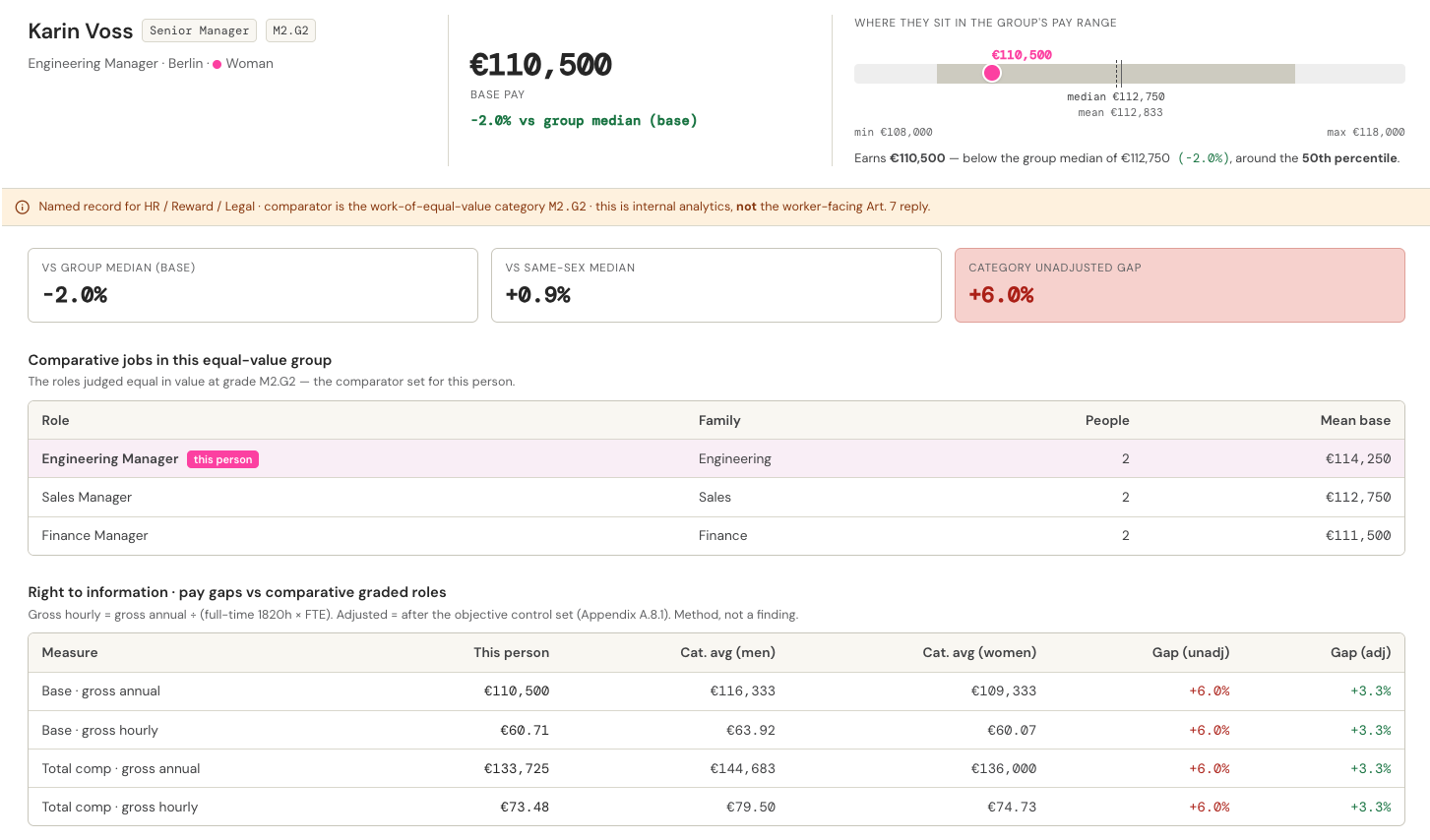
Compensation IQ EU Pay Transparency Article 7 right-to-information response document, generated from categorised pay data
Security and compliance

Your data’s security is our top priority

We understand the sensitivity of compensation data. That’s why Compensation IQ is built with security and integrity first. Our practices are aligned with ISO 27001 and our policies and procedures are compliant with GDPR.

SOC 2 certified

SOC 2

GDPR compliant

GDPR

Cyber Essentials certified

Cyber Essentials

Ready to move from data chaos to compliance?

From first Article 7 request to first Article 9 report. One platform. Built for the Directive.

See pricing

Frequently asked questions

What is the EU Pay Transparency Directive?

The EU Pay Transparency Directive is Directive (EU) 2023/970, adopted on 10 May 2023. It sets minimum requirements for pay transparency and equal-pay enforcement across all 27 EU Member States, transposed into national law by 7 June 2026. Most obligations - including the Article 7 right to information - apply to every employer regardless of size.

What is Article 7, the right to information?

Article 7 of the EU Pay Transparency Directive (Directive (EU) 2023/970) is the right to information - any worker can request their own pay level and the average pay levels by sex for workers doing the same work or work of equal value. It applies to every employer regardless of size. Employers must respond in writing within two months.

What counts as “pay” under the Directive?

Article 3(1)(a) of the EU Pay Transparency Directive (Directive (EU) 2023/970) defines “pay” as ordinary basic wage or salary AND any other consideration, cash or in kind, a worker receives from their employer. That covers bonuses, overtime, allowances, benefits in kind, occupational pensions, statutory sick pay and dismissal payments. Recital 21 confirms this is a floor - Member States and collective agreements can add to it.

What is the difference between Article 7 and Article 9?

Article 7 of the EU Pay Transparency Directive is the right to information - a worker’s request answered in two months, applies to every employer. Article 9 is the pay gap reporting duty - seven statutory metrics to the national monitoring body, phased by headcount. First Article 9 reports are due 7 June 2027 for 250+ workers and 150-249 workers; 100-149 workers first report by 7 June 2031.

What is a Joint Pay Assessment (JPA)?

A Joint Pay Assessment is required by Article 10 of the EU Pay Transparency Directive when three conditions are met: a category gender pay gap of at least 5%, not justified on objective, gender-neutral criteria, and not remedied within six months of the pay gap report. It’s carried out by the employer with workers’ representatives. For 250+ workers, the first JPA obligation follows six months after the first Article 9 report due 7 June 2027.

What does “same work or work of equal value” mean?

Article 4(4) of the EU Pay Transparency Directive requires pay structures to enable assessment of whether workers are in a comparable situation, on objective, gender-neutral criteria - skills, effort, responsibility and working conditions. Workers doing the same work or work of equal value form a “category of workers” under Article 3(1)(h). Pay comparisons for Article 7 responses and Article 9 reporting are made across each category.

Do employers with fewer than 100 workers have to report under Article 9?

Article 9 of the EU Pay Transparency Directive does not require mandatory gender pay gap reporting for employers under 100 workers - Article 9(5) makes it voluntary. Member States may require it by national law (France retains 50, Lithuania 20). Every employer, regardless of size, is subject to the Article 7 right to information, the Article 5 recruitment transparency requirement, and the Article 18 burden of proof.

How does Article 18 change the burden of proof?

Article 18 of the EU Pay Transparency Directive reverses the burden of proof in equal-pay discrimination claims. Where a worker establishes facts from which discrimination may be presumed, the employer must prove no direct or indirect discrimination occurred. Documentation and traceability of every pay decision back to Article 4 gender-neutral criteria is the practical response.

Which countries does Compensation IQ EU Pay Transparency cover?

Compensation IQ EU Pay Transparency covers all 27 EU Member States required to transpose Directive (EU) 2023/970 into national law by 7 June 2026. The platform handles multi-country pay components in local languages, formats and fiscal calendars. Where a Member State transposes rules stricter than the Directive’s minimum (Article 27(1)), the stricter national rule binds locally.

How does Compensation IQ handle multi-country pay components?

Compensation IQ pulls pay data from your HRIS, country payroll providers and supplementary spreadsheets into one validated view, then classifies every component under Article 3 of the EU Pay Transparency Directive with the citation stored per decision. 50+ HRIS integrations plus guided CSV upload for country payroll systems. Country pay components (Weihnachtsgeld, dodatek, thirteenth-month, functional allowances) classified in their local language.